Contemporary American translator and writer
Eliot Weinberger is an essayist, political commentator, translator, and editor. His books of avant-gardist literary essays include Karmic Traces, An Elemental Thing (named by the Village Voice as one of the "20 Best Books of the Year") and, most recently, Oranges & Peanuts for Sale. His political articles are collected in What I Heard About Iraq – called by the Guardian the one antiwar "classic" of the Iraq war– and What Happened Here: Bush Chronicles. The author of a study of Chinese poetry translation, 19 Ways of Looking at Wang Wei, he is the translator of the poetry of Bei Dao, and the editor of The New Directions Anthology of Classical Chinese Poetry and a forthcoming series from Chinese University Press of Hong Kong. His other anthologies include World Beat: International Poetry Now from New Directions and American Poetry Since 1950: Innovators & Outsiders. Among his translations of Latin American poetry and prose are the Collected Poems 1957-1987 of Octavio Paz, Vicente Huidbro's Altazor, and Jorge Luis Borges’ Selected Non-Fictions, which received the National Book Critics Circle award for criticism. He was born in New York City, where he still lives. Often presented as a "post-national" writer, his work has been translated into thirty languages, and appears frequently in the New York Review of Books, the London Review of Books, and periodcials and newspapers abroad.
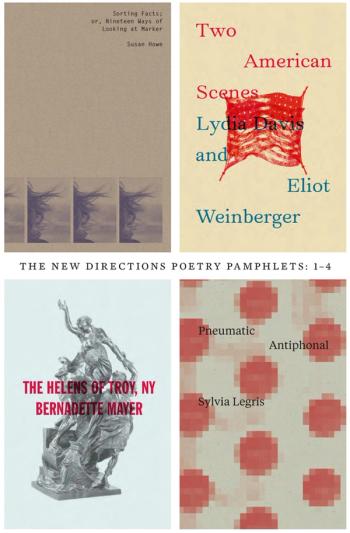
Poetry Pamphlets 1–4
Two American Scenes
Oranges & Peanuts For Sale
An Elemental Thing
What Happened Here
Karmic Traces
Outside Stories 1987-1991
Works On Paper
The Poems of Octavio Paz
Seven Nights
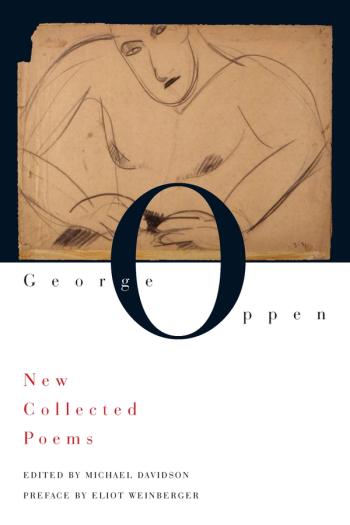
New Collected Poems
Figures & Figurations
My Emily Dickinson
World Beat
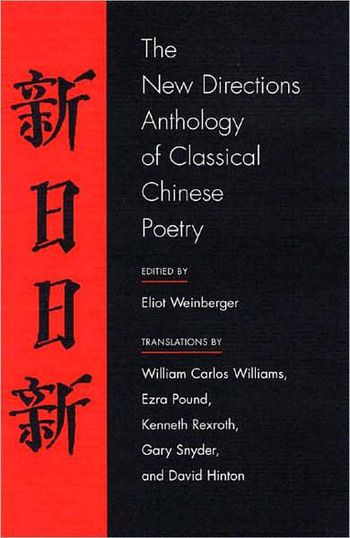
The New Directions Anthology Of Classical Chinese Poetry
Unlock
Collected Poems 1957-1987
The Selected Poetry Of Vicente Huidobro
photo credit: Nina Subin
“One of the delights of reading his essays is that they reveal the interconnections between the two; the Wittgensteinian idea that the limits of one’s language are the limits of one’s world becomes, in his hands, a tool for revealing the blind spots common to our culture.”
— Scott Saul, The Nation on Eliot Weinberger's Oranges & Peanuts For Sale
“From modernist poetry he has learned, as an essayist, about collage and the need for concision and exactitude. He has taken to heart poetics' fluid conflictions between the public and the personal, its conflation of the contemporary and the archaic, and its taste for the encyclopedic. Many of the essays from the first two books, Works on Paper and Outside Stories, are not essays as we know them, but rather dismantlements and explorations of the essay form.”
— Eli Gottlieb, The Village Voice on Eliot Weinberger's Works On Paper
“There is no one like Shabtai: an erudite classicist who writes poems of voltaic frankness and political rage. These lyrics of a patriot betrayed by his government are both timely and timeless. Written for the newspapers, they will endure long after their referents are forgotten. But we are marooned in the present, and J’Accuse is the one new book of poetry that should be read right now.”
— Eliot Weinberger on J’accuse
“Famous in Europe, unknown here, Inger Christensen is a formalist who makes her own rules, then turns the game around with another rule.”
— Eliot Weinberger on Inger Christensen's Butterfly Valley
“There is no question that American literary history will have to be rewritten to accommodate Rexroth... And it will have to take into account one of the more startling transformations in American letters: that Rexroth, the great celebrant of heterosexual love... devoted the last years of his life to becoming a woman poet. ”
— Eliot Weinberger, Works on Paper on
“A child who paid for the political sins of her grandparents in Hoxha's Albania; a young poet who seems to have been writing for a hundred years in a language that's only been written for a hundred years; an erotic lyricist in the ruins of a state; Luljeta Lleshanaku is the real thing, and as unexpected as an oasis behind a mountain on the moon.”
— Eliot Weinberger on Fresco
“Four paths of a lifetime's learning converge in these poems: Eroticism, from the Sanskrit; Satire, from the Latin; Plain Speech, from the American; and, above all, from the Greek: Perfection.”
— Eliot Weinberger on The Secret Room
“Laughlin was more than the greatest American publisher of the twentieth century: His press was the twentieth century.”
— Eliot Weinberger, Nation on The Way It Wasn’t
Gu Cheng
Bilge Karasu
Miroslav Krleža
Martín Adán
Katherine Silver
Donald D. Walsh
Joyce Cary