20th Century American poet, essayist, and translator.
Kenneth Rexroth (1905-1982) was an American poet, translator, essayist and social critic who played a key role in the San Francisco Renaissance of the 1950s and 1960s. His poems are characterized by such an unusual range of concerns that he often began his poetry readings by wryly asking the audience: "Well, what would you like tonight: sex, mysticism or revolution?" Though almost entirely self-educated, his erudition was astonishingly broad-ranging, as reflected in essays on topics as diverse as ancient Chinese science, modern jazz, American Indian songs, California mountaineering, medieval mysticism, avant-garde art and utopian communities. He connected with New Directions from the very beginning, and was both friend and adviser to James Laughlin for the rest of his life. New Directions published most of his books of poetry, including Collected Shorter Poems (1966), Collected Longer Poems (1968), and Selected Poems (1984); his plays (Beyond the Mountains, 1951); his Autobiographical Novel (1964; expanded edition, 1991); several collections of essays (Bird in the Bush, 1959; Assays, 1961; World Outside the Window: Selected Essays, 1987; Classics Revisited, 1986; More Classics Revisited, 1989); and numerous volumes of translations, including 100 Poems from the Chinese, 100 Poems from the Japanese, Women Poets of China, Women Poets of Japan, and Selected Poems of Pierre Reverdy.
In the Sierra
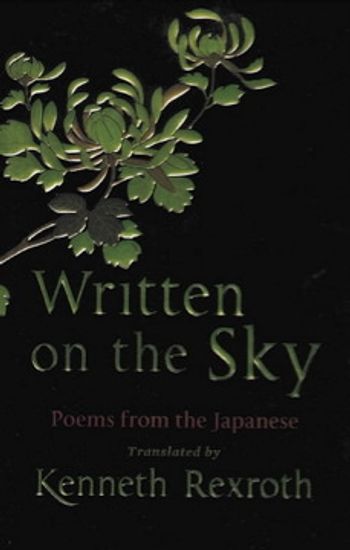
Written On The Sky
Songs Of Love, Moon & Wind
Beyond The Mountains
An Autobiographical Novel
More Classics Revisited
World Outside The Window
Classics Revisited
Selected Poems of Kenneth Rexroth
Women Poets Of China
Women Poets Of Japan
One Hundred More Poems From The Japanese
One Hundred Poems from the Chinese
The Collected Longer Poems
One Hundred More Poems From The Chinese
The Collected Shorter Poems of Kenneth Rexroth
One Hundred Poems From The Japanese
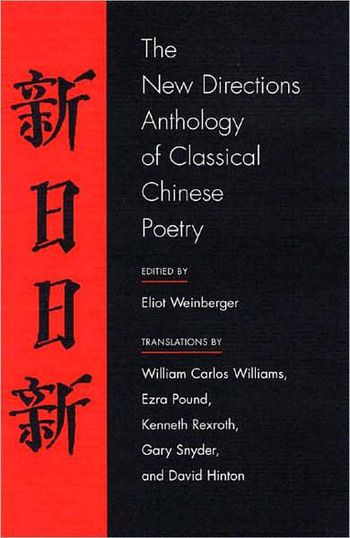
The New Directions Anthology Of Classical Chinese Poetry
“To define strangeness with no great strain is the peculiar province of art; and it is as a master of this great art that Kenneth Rexroth defines and defends our earth for us.”
— The New York Times Book Review on Kenneth Rexroth
“His is a deeply satisfying, profoundly philosophic poetry of the world realization. No need to shout about it. No need to praise. His is the art to accept the vastness of life and give us his sure sense of it, serene, open.”
— The Nation on Kenneth Rexroth's The Collected Longer Poems
“Jerome Rothenberg is one of the truly contemporary American poets who has returned U.S. poetry to the mainstream of international modern literature.... No one writing today has dug deeper into the roots of poetry.”
— Kenneth Rexroth on Kenneth Rexroth's Pre-Faces & Other Writings
“So these 50-odd stories are among the most precious possessions of the 20th century in any language. And when they come to ask, 'What were they like?' we can say, 'This is us.'
”
— Kenneth Rexroth, The New Leader on The Collected Stories of William Carlos Williams
“Perfect clarity of vision, perfect clarity of utterance, perfect control of the material means.”
— Kenneth Rexroth on Richard Eberhart
“An accomplished technician who has learned from the poetry of several languages and who has developed a sure and flexible style capable of handling any material he wishes.”
— Kenneth Rexroth on Gary Snyder
“One of the most outstanding poets of his generation.”
— Kenneth Rexroth on Nathaniel Tarn
“Wang Wei is one of those model poets, personally and artistically flawless, who occur very rarely in the history of literature.”
— Kenneth Rexroth on Wang Wei
“Jerome Rothenberg is one of the truly contemporary American poets who has returned U.S. poetry to the mainstream of international modern literature. At the same time, he is a true autochthon. Only here and now could have produced him––a swinging orgy of Martin Buber, Marcel Duchamp, Gertrude Stein, and Sitting Bull.”
— Kenneth Rexroth on Jerome Rothenberg
“No one writing today has dug deeper into the roots of poetry.”
— Kenneth Rexroth on Jerome Rothenberg
“Shiraishi is the Allen Ginsberg of Japan.”
— Kenneth Rexroth on Kazuko Shiraishi
Kamau Brathwaite
Kenneth Patchen
Robyn Creswell
D. Smith
Robert Duncan
Gary Snyder
William Everson